
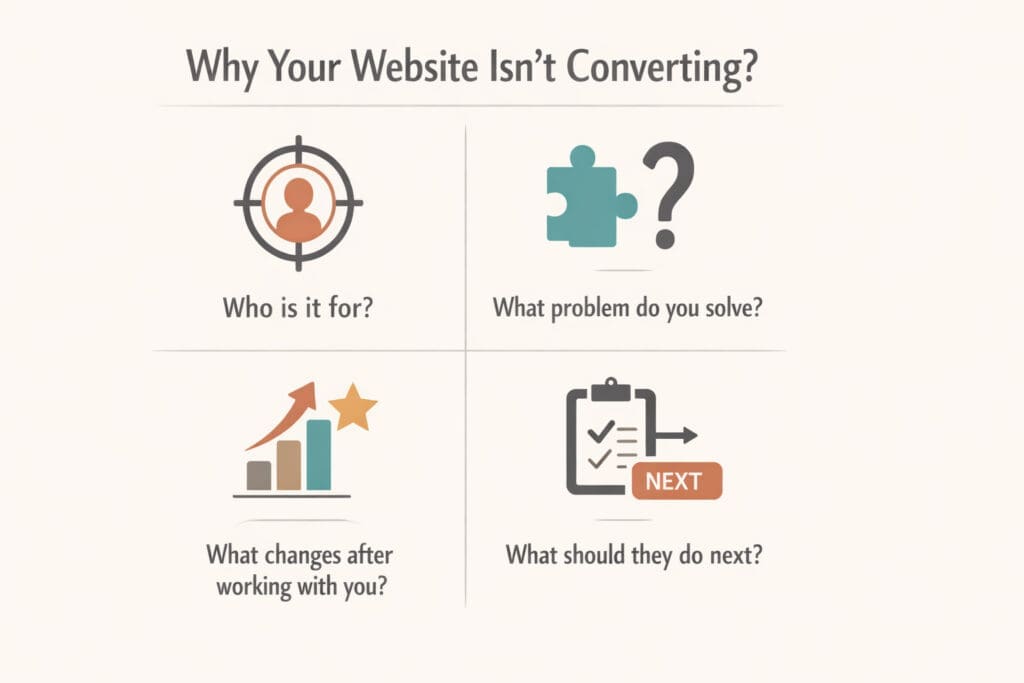
A website can look polished and still fail to generate inquiries if visitors cannot quickly understand who it is for, what problem it solves, what results it delivers, and what to do next. When any of those elements are unclear, people hesitate, and hesitation lowers your website conversion rate.
Many service-based businesses experience this situation. The website looks professional. The messaging sounds reasonable. Traffic may even be increasing. But inquiries remain inconsistent.
In this article, we will break down the most common reasons a website fails to convert and how to identify the real issue.
You will learn:
- Why websites that “sound good” can still struggle to convert
- The messaging gaps that cause visitors to hesitate or leave
- How unclear positioning lowers website conversion rates
- Why traffic increases do not always lead to more inquiries
- The structural issues that quietly block conversions
- How to diagnose whether the problem is messaging, positioning, or site structure
Once you understand where conversions break down, it becomes much easier to correct the problem and turn website visits into real inquiries.
If you want help identifying where your own site may be losing potential clients, request a website review with H|C Marketing today.
Why a “Good” Website Still Fails to Convert
If your website looks good and sounds good but is not bringing in inquiries, you’re probably wondering what’s missing. This is a common frustration for established service-based businesses. The site looks the way you wanted it to look. It represents your business. But it is not bringing in consistent work.
When that happens, it is rarely a reflection of your business, your capability, your website, or the quality of your work. More often, there is a disconnect between what a potential client needs to hear and what your website is actually communicating.
That disconnect is often subtle, but it directly affects whether someone stays on your site, trusts you, and feels confident enough to take the next step.
The Real Reason Your Website Is Not Converting
Most underperforming websites break down in three core areas: audience clarity, positioning strength, or conversion sequencing. When even one of these is underdeveloped, results suffer. To understand why your website is not converting, you have to evaluate each of them carefully.
Your Website Is Clear to You, But Not to Your Buyer
This is one of the most common website messaging issues we see.
You understand your process, your differentiators, your client journey, and the outcomes you deliver. But your potential client does not.
When messaging clarity is missing, visitors start asking themselves important questions:
- Is this for someone like me?
- Do they actually understand the problem I am dealing with?
- What happens if I say yes?
- Why would I choose this over other options?
When those answers are not obvious, visitors disengage and move on.
Quick Diagnostic
When someone lands on your homepage, can they determine the answers to these questions within just a few seconds?
- Who is this for?
- What problem do you solve?
- What result do you produce?
If those answers are not obvious at a glance, your homepage is not doing its job.
Your Services Are Clear. The Value Isn’t.
It is possible for your website to sound polished and still feel forgettable.
Many businesses clearly describe what they do:
- We provide professional landscaping services.
- We offer comprehensive home remodeling.
- We deliver reliable IT support.
There is nothing technically wrong with these statements. They are professional. They are safe. They are also vague enough that dozens of competitors could say the exact same thing.
The problem is not the clarity of the service. It is the clarity of the impact.
Strong messaging does not just describe the work. It makes a specific, defensible claim about what changes for the client.
For example:
- We design low-maintenance landscapes that eliminate the constant upkeep most homeowners struggle with.
- We remodel kitchens so families gain storage, functionality, and a layout that actually works day to day.
- We manage IT systems so small businesses stop losing time to preventable tech problems.
The difference is precision and consequence. One blends in. The other creates contrast.
Low website conversion rates often stem from language that feels interchangeable. If your copy could live on another company’s website with only minor adjustments, it is not distinct enough to convert. Even if potential clients cannot fully articulate why, they can sense when a message feels generic.
Traffic Went Up. Inquiries Didn’t.
This is where many business owners get stuck.
You invested in SEO. You optimized pages. Maybe you even started ranking. Traffic increased. But your inquiries did not.
That disconnect feels confusing. If more people are visiting your website, shouldn’t more people be reaching out?
Not necessarily.
When someone searches for a specific problem, they are looking for a specific answer. If they land on your website and it does not clearly address what they came for, they hesitate. Even if your services are relevant. Even if you are capable of helping.
SEO can bring someone to your site. But your messaging is what makes them feel confident enough to take the next step. If those two are not working together, traffic alone will not convert.
You’re Leading With Credentials Instead of Connection
Your experience and credentials matter. But most people do not arrive on your website looking to evaluate who is the most impressive. They are trying to figure out whether you understand what they are dealing with.
Before someone cares about your background, they want to recognize their problem in your words. They want to see that you understand the situation and that you can solve it.
Once that is clear, authority becomes powerful. At that point, your experience, certifications, and methodology help them decide that you are not just capable but the right choice.
Expertise closes the decision. Understanding opens the door.
My Website Feels Fine. But No One Is Taking Action.
This is a frustrating one and often the hardest issue to recognize.
Your website looks polished. The writing is clear. Nothing feels obviously wrong. And yet, inquiries are inconsistent.
In many cases, the issue is not grammar or design. It is conviction.
Your site may clearly explain what you do. It may outline your services and describe your process. But if it does not show someone how you would actually help them, it falls flat.
People are not just scanning for services. They are looking for insight. They want to feel like they are learning something about their situation just by reading your site. They want to think, “That’s exactly what’s happening,” or “That makes sense.”
Common signs of this include:
- Too many services are competing for attention
- Vague calls to action like “Learn More.”
- No clear picture of the outcome
- Benefits that sound positive but are undefined
If your site only describes your work without making the reader feel understood or better informed, there is no reason to keep scrolling.
Sometimes the Problem Isn’t the Website
There are times when the issue goes deeper than copy or design.
If you are not clear about your objectives, your audience, or the specific problem you solve best, that lack of definition shows up in the language, and your website starts to sound uncertain. When your messaging feels uncertain, people question whether you truly know what you are doing.
Defined objectives create defined messaging. Defined messaging builds trust. And trust improves conversions.
When It Actually Is a Website Structure Problem
Sometimes the issue is not just what your website says. It is how it is organized.
Common structural problems include:
- The homepage talks about everything but guides visitors to nothing
- Services are listed, but there is no clear next step after reading about them
- Important information is buried several clicks deep
- The call to action changes from page to page
- There are multiple offers competing for attention on the same page
- The contact or booking button is hard to find
- Pages exist, but they do not logically lead into one another
When this happens, visitors may feel slightly disoriented. They are interested, but they are not sure where to go or what to do next. And when the path is unclear, most people do not search for it. They leave.
In those cases, restructuring the website can absolutely help.
A strong website makes it obvious what you do, who it is for, and what someone should do next. The structure should guide that process, not complicate it.
How We Diagnose and Fix a Website That Isn’t Converting
When someone comes to us frustrated that their website is not bringing in inquiries, we do not start with surface edits. We look closely at three areas: audience clarity, offer clarity, and structure.
We start by identifying where clarity breaks down.
In most cases, it comes back to five areas:
1. Audience Clarity
If the website tries to speak to everyone, it speaks clearly to no one, so:
Who the business is built for.
Who it is not for.
What problem does it solve best?
2. Message Specificity
Many websites explain services, but do they show:
What changes for the client?
What the transformation actually looks like.
What makes the offer distinct?
3. Offer Structure
Sometimes services compete with each other. Sometimes the next step is unclear. We evaluate:
Whether there are too many options.
Whether the call to action is obvious.
Whether each page leads naturally to the next.
4. Business-Level Direction
If the business is new or still evolving, that evolution often shows up in the website messaging. We make sure that your website reflects:
What the business wants to be known for.
What it does better than competitors.
What it intentionally does not offer.
5. Structure and Flow
If the messaging is strong but the layout is confusing, we address the structure. We check:
Navigation clarity.
Service page organization.
A defined path toward inquiry.
Sometimes this work leads to a focused messaging intensive. Sometimes it leads to a full website build. Sometimes it reveals an SEO gap that needs to be addressed.
But the process always starts the same way: define the message, narrow the focus, then build the site around that clarity.
A website does not convert because it looks impressive. It converts because people understand it and know what to do next.
Why My Website Isn’t Converting (Common Questions)
Why does my website look good but still not bring in leads?
A website can look professional and still underperform if people do not immediately understand why they should choose you. If your message is broad, the outcome is unclear, or the next step is not obvious, visitors hesitate. And hesitation online usually means they leave.
How can I tell if the problem is my messaging and not my design?
If you regularly explain your services more clearly in conversation than your website does, messaging is likely the issue. Your website should communicate your value without you having to clarify it live. If people are confused after reading your site, the structure may be fine, but the message needs work.
Should I focus on SEO or messaging first?
Messaging comes first. SEO brings people to your website, but messaging is what convinces them to take action. Driving more traffic to an unclear message only amplifies the problem.
How do I know if I need a new website or just better messaging?
If visitors struggle to understand what you do or what changes after working with you, start with messaging. If the message is clear but the layout makes it hard to navigate or take the next step, the structure may need attention. Redesigning without clarifying the message often recreates the same issue in a new format.
What is a normal website conversion rate for a service business?
It varies depending on traffic quality and price point, but many service-based businesses see between 2 and 5 percent when messaging and audience alignment are strong. If you are below that range with qualified traffic, it is worth evaluating your positioning and clarity.
Why do referrals convert, but my website doesn’t?
Referrals come with built-in trust. By the time someone lands on your site, they already believe you are capable. Cold visitors do not have that advantage. Your website has to build that confidence on its own, and that requires clear positioning and defined outcomes.
Can better messaging really increase inquiries?
Yes. When people clearly understand who you help, how you help them, and what the next step is, decision-making becomes easier. Clear messaging reduces hesitation, and reduced hesitation increases action.
If Your Website Feels Fine but Still Isn’t Working
When a website isn’t working, it isn’t random. It usually means something important is unclear to the people you are trying to reach.
If you have a sense that your website should be working better than it is, that is a good instinct. The next step is identifying where potential clients’ confidence drops. Because when your website clearly communicates who you help, how you help them, and what to do next, hesitation decreases.
Easier decisions lead to more inquiries.
Find Out What’s Actually Blocking Conversions
If your website looks solid but inquiries are inconsistent, there is usually a specific point where potential clients lose confidence. The challenge is identifying where that breakdown occurs.
At H|C Marketing, we review websites through the same framework outlined in this article. We evaluate audience clarity, positioning strength, and structural flow to determine why a site attracts visitors but fails to convert.
If you want a clearer understanding of what may be holding your site back, you can request a website review, and we will walk you through the findings.
About the Author
Written by Cat O’Brien
Content Strategist, H|C Marketing
Cat focuses on SEO-driven content strategy and editorial planning for service-based businesses. Her work helps brands turn clear messaging and structured content into consistent visibility and long-term growth.

Be the first to comment