
Blogging often fails because posts are written without a clear strategy connecting them. Search engines rely on topic depth, internal structure, and clear signals of expertise to understand what a website should rank for. Strategic blogging organizes content around real search intent and structured topic clusters so articles support one another and build long-term visibility.
At H | C Marketing, we help businesses design content systems that align with modern SEO, emerging AI-driven search, and clear brand messaging so blogs contribute to authority rather than existing as disconnected posts.
Why Many Businesses Start Blogging Without a Strategy
Most businesses start blogging with good intentions.
Someone suggests blogging helps SEO. A marketing article mentions it can increase website traffic. Or a business owner notices competitors publishing regularly and assumes it must be something they should be doing too.
So they begin writing.
A post goes live. Another appears a few weeks later. Maybe a third shows up months after that when someone finds the time again.
Eventually the same question comes up:
“Why isn’t our blog doing anything?”
Traffic hasn’t increased. Leads aren’t coming from the blog. And the time spent writing those articles doesn’t seem to be producing meaningful results.
At that point, it’s easy to assume blogging simply doesn’t work.
But blogging rarely fails on its own. More often, the issue is blogging without a strategy guiding what topics are published and how those articles connect to the expertise of the business.
Without direction, blog posts often become isolated pieces of content that never build momentum. Search engines struggle to understand what the site should rank for, and readers struggle to see the depth of knowledge behind the brand. Over time, the blog becomes something that technically exists on the website but doesn’t contribute meaningfully to visibility or growth.
This article breaks down why blogging without a strategy fails and what businesses can do differently.
In this guide, we’ll cover:
• what blogging without a strategy actually looks like
• why random blog posts struggle to perform in search
• how disconnected content prevents authority from building
• why blog topics must align with real search intent
• what strategic blogging looks like in practice
• how businesses can shift from scattered posts to a structured content system
Understanding these patterns is the first step toward building a blog that actually supports long-term growth.
If you’re already thinking about improving your content approach, H | C Marketing helps businesses build thoughtful blog strategies designed for both traditional search and the evolving landscape of AI-assisted discovery.
What a Blogging Strategy Actually Is
Before discussing why blogs fail, it helps to clarify what a blogging strategy actually involves.
A blog strategy is simply a plan that guides what topics you publish, why those topics matter, and how each article connects to the larger expertise of the business. Instead of writing posts whenever an idea appears, strategic blogs organize content around clear themes that reflect what the company wants to be known for.
This structure helps both readers and search engines understand the purpose of the blog.
For readers, a strategic blog feels organized and helpful. Articles build on each other, gradually expanding a topic so the audience can explore it in depth. For search engines, the pattern signals that the website consistently demonstrates expertise in a specific subject area.
Just as importantly, strategy helps ensure the content reflects the voice and perspective of the brand. Readers begin to see not only what the company knows, but how it approaches the problems its clients face.
Without that structure, even well-written articles can struggle to perform.
Individual blog posts may still contain useful information, but they rarely work together to build authority or visibility.
Why Blogging Without a Strategy Fails
When blogging fails to generate traffic, engagement, or leads, the issue is rarely the quality of the writing itself. In most cases, the underlying problem is structural.
Several patterns tend to appear repeatedly in blogs that lack direction.
Search Engines Cannot Identify What the Website Is Known For
Search engines try to determine what topics a website consistently demonstrates expertise in.
When multiple articles explore related questions, those posts begin reinforcing one another. Over time, this creates a clear signal that the website provides depth in that subject area.
Random blogging rarely creates that signal.
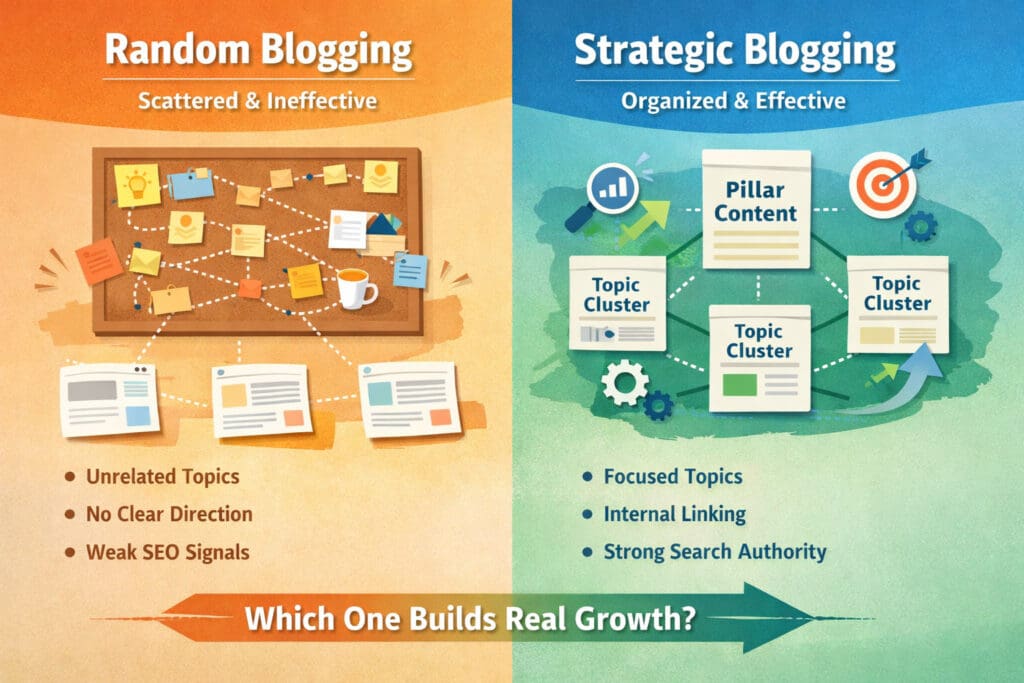
If one article discusses branding, another explores productivity, and another covers general marketing trends, search engines struggle to interpret what the site should rank for. Even if each article is helpful on its own, the overall pattern of expertise becomes difficult to identify.
From an SEO perspective, random blog posts rarely provide strong signals about what a website should rank for.
Strategic blogs approach this differently. Instead of jumping between unrelated ideas, they expand a topic gradually, allowing authority to build over time.
Blog Topics Often Ignore Search Intent
Another common issue appears when blog topics are chosen based on what the business finds interesting rather than what potential clients are actually searching for.
This usually happens unintentionally. Teams brainstorm ideas internally, assuming those ideas will resonate with readers. But if those topics don’t match the questions people are typing into search engines, the content may never reach the audience it was meant to help.
Strategic blogging begins with understanding search intent.
Instead of asking “What should we write about?” the process starts with “What questions are people already asking?” When blog posts answer those questions clearly, they naturally align with search behavior and become easier for search engines to surface.
For a deeper explanation of how search intent shapes content strategy, see our guide to understanding search intent in SEO.
Content Never Builds Momentum
One of the quiet advantages of strategic blogging is that content can begin reinforcing itself over time.
Each article expands the coverage of a topic. When several posts explore related ideas, they start strengthening one another. This gradual accumulation of expertise is often referred to as content compounding.
Random blogging interrupts that process.
When topics shift constantly, each article starts from zero instead of benefiting from the authority of previous posts. As a result, the blog grows wider but not deeper.
Strategic blogs grow differently. Over time they begin to feel less like a series of individual posts and more like a connected body of knowledge.
Blog Posts Become Isolated Pages
Another pattern that appears in unplanned blogs is the lack of connection between posts.
Search engines rely on internal links to understand how ideas relate to one another across a website. When blog posts are written randomly, they rarely link together in meaningful ways.
This creates isolated pages rather than an interconnected resource.
Strategic blogs intentionally connect related articles. These internal links help search engines interpret topic depth while guiding readers toward additional information that may help them understand a subject more clearly.
Without that structure, blog posts struggle to support one another.
For a deeper look at this structure, see our article on topic cluster SEO strategy.
Content Drifts Away From Business Goals
Many businesses unintentionally write blog posts that have little connection to the services they offer.
The topics may feel relevant to the industry, but they don’t necessarily guide readers toward understanding the expertise behind the company. Over time, the blog begins to attract readers who are interested in general information rather than the problems the business actually solves.
Strategic blogging approaches topics differently.
Articles are chosen not only because they are interesting but because they relate directly to the challenges the business helps clients solve. This alignment ensures that the blog strengthens both visibility and credibility at the same time.
Preparing to Fix a Blog Without Strategy
Before improving a blog, it helps to step back and identify what should guide future content.
Many struggling blogs share the same patterns. Topics are chosen randomly, publishing is inconsistent, and internal connections between articles are missing. These blog planning mistakes often prevent content from building the authority search engines look for.
Most businesses that successfully shift their blogging approach begin by clarifying the areas of expertise they want their website to represent. These topics often align closely with the services the company provides.
From there, keyword research can reveal the questions people are already searching for within those topics. Instead of guessing what readers might want to know, the blog can focus on answering real search queries.
Finally, establishing a consistent publishing rhythm helps reinforce authority signals over time. Even one well-planned article per month can gradually build visibility when it supports a clear topic structure.
If you’re building a content plan, our guide to how to build a blog content strategy explains how to structure topics and publishing schedules.
How Strategic Blogging Actually Works
Once a clear direction is in place, blogging begins to function very differently.
At H | C Marketing, this process usually begins by clarifying what a brand wants to be known for. From there, content topics are mapped to real search behavior so the blog supports both visibility and credibility.
Core Topics Create the Foundation
Strategic blogs usually begin with a small set of core topics the business wants to be known for.
For a marketing company, those topics might include areas like content strategy, SEO structure, brand messaging, or website copy.
Each topic becomes the foundation for future articles.
Instead of publishing unrelated posts, the blog gradually expands these subjects so readers can explore them from multiple angles.
Topic Clusters Organize the Content
Once core topics are identified, articles begin forming topic clusters.
A central article may introduce the broader subject, while additional posts explore specific questions related to that topic. Over time, these clusters create a structured network of knowledge that reinforces the website’s expertise.
This structure helps both readers and search engines understand how the content fits together.
Internal Links Connect the System
Strategic blogs also rely on internal linking to connect related articles.
These links help readers explore topics more deeply while allowing search engines to interpret how ideas relate across the website.
Instead of existing as independent posts, the articles begin supporting one another.
Consistency Builds Authority
Strategic blogging does not require publishing large volumes of content.
In many cases, one thoughtful article per month can gradually build authority when it supports a clear topic structure.
Consistency allows search engines to recognize the website as an active resource within its subject area.
Why Strategic Blogs Compound Over Time
One of the most important differences between random blogging and strategic blogging is how results accumulate.
A single article may take time to gain visibility. But when multiple related posts support the same topic, they begin reinforcing one another. Each article expands the website’s coverage of that subject, gradually strengthening the authority of the entire blog.
Over time, search engines gain greater confidence that the website provides meaningful expertise in that area.
This is why strategic blogs often become stronger as they grow.
Random blogging rarely produces the same effect because the content never forms a clear structure. Without that structure, each article exists independently rather than contributing to a larger system of knowledge.
Blogging Strategy FAQs
Why does blogging sometimes fail?
Blogging usually fails when content is published without a strategy. Random topics, inconsistent publishing, and lack of keyword research make it difficult for search engines to understand what the website should rank for.
Does blogging still help SEO?
Yes. Blogging remains one of the most effective ways to build organic search visibility when articles are aligned with search intent and organized around clear topics.
How often should businesses blog?
Consistency matters more than frequency. Many businesses see strong results publishing one well-planned article per month.
Do random blog posts hurt SEO?
Random posts typically do not harm SEO, but they rarely help build authority. Strategic content performs better because articles support each other.
What is a blog content strategy?
A blog content strategy is a plan that determines what topics will be published, how often they will appear, and how those posts support broader marketing goals.
The Real Difference Between Random Blogging and Strategic Blogging
Blogging itself is not the problem.
The challenge many businesses encounter is blogging without a clear strategy guiding their content. When topics lack alignment, search intent isn’t considered, and posts exist without internal structure or consistency, even well-written articles can struggle to produce meaningful results.
With the right foundation in place, however, blogging becomes one of the most effective long-term tools for building visibility, authority, and trust.
The difference isn’t simply writing more content. It’s creating content with purpose and allowing that purpose to guide how the blog grows over time.
At H | C Marketing, we help businesses step back and build that structure intentionally. Our work combines content strategy, SEO architecture, and brand messaging to create blog systems designed to support both traditional search visibility and the evolving landscape of AI-driven search.
If your blog hasn’t been producing the results you expected, the issue may not be the writing itself. In many cases, the missing piece is simply a clear strategy behind the content.
And that’s exactly the kind of work H | C Marketing helps businesses build.
Build a Blog Strategy That Actually Works
Many businesses begin blogging with good intentions but without a clear plan guiding what topics to publish, how those topics connect, or how the content supports long-term visibility.
H | C Marketing helps companies step back and design blog strategies intentionally. That process includes identifying the subjects your business should be known for, mapping those topics to real search behavior, and structuring content so each article strengthens the authority of the entire website.
Instead of publishing disconnected posts, the goal is to build a content system that grows stronger over time.
If you’re ready to move from scattered blogging to a clear, structured content strategy, explore our SEO Content Strategy services or contact H | C Marketing to start the conversation.
About the Author
Written by Hope Denton
Co-Founder, H | C Marketing
Hope Denton is a content strategist and SEO specialist who helps service-based businesses build websites and blog systems that support long-term search visibility. Through H | C Marketing, she works with brands to clarify their messaging, structure their content intentionally, and turn website traffic into meaningful growth.

Be the first to comment